Digital Portfolio Workshop + Resume-to-Portfolio Workflow
A CS/AI Ambassador workshop helping students turn resumes, projects, and accomplishments into live professional portfolio sites.
- ↗ Helped students turn resumes and projects into professional portfolios.
- ↗ Guided students through customization and GitHub Pages deployment.
- ↗ Used a Custom GPT resume-to-portfolio workflow to make the process faster and more accessible.
- ↗ Created a foundation for resources and services around portfolio systems.
Overview
Through the University of Arizona CS Ambassadors and Department of Computer Science, I helped host a Digital Portfolio Workshop focused on one practical outcome: students should not just learn about portfolios. They should leave with something live.
The workshop helped students turn resumes, projects, and accomplishments into online portfolios using templates, GitHub Pages deployment, and a Custom GPT resume-to-portfolio workflow.
This was built as a practical career-readiness system: students came in with scattered experience and left with a clearer public-facing story.
The problem
Students often have real projects, internships, coursework, and leadership experience, but those experiences remain hidden inside resumes or scattered across GitHub.
A resume tells the story in one page. A portfolio helps people see the work.
The challenge is that many students do not know how to translate their experience into a website. They may have strong work, but they struggle with structure, language, layout, deployment, and confidence.
My role
I contributed as a CS/AI Ambassador and portfolio systems builder.
My role was to help shape the workflow, resources, and guidance that allowed students to move from raw resume content to a published professional presence.
I focused on making the process practical and repeatable:
- Start with existing resume/project content
- Convert that content into portfolio sections
- Use a template instead of starting from zero
- Explain deployment clearly
- Help students understand how to present proof, not just claims
Product decisions
The workshop was designed around reducing friction.
The core product decisions were:
- Use a portfolio template so students do not start from a blank screen
- Translate resume bullets into web sections
- Make deployment simple with GitHub Pages
- Use a Custom GPT workflow to help structure content
- Focus on visible proof: projects, links, screenshots, and outcomes
- Give students a long-term career asset, not just a one-time activity
The goal was not to make every portfolio perfect in one workshop. The goal was to make the first version real, live, and improvable.
The workflow
The workshop followed a simple resume-to-portfolio flow:
- Students identified the most important parts of their resume.
- They separated experiences into projects, work, leadership, skills, and contact sections.
- They used a template to avoid design paralysis.
- They used the AI-assisted workflow to turn rough bullets into cleaner portfolio copy.
- They customized the site.
- They deployed the portfolio through GitHub Pages.
This created a repeatable process students could keep improving after the workshop.
Impact
Students left with live, shareable portfolio foundations that could support internships, job applications, networking, and personal branding.
The workshop also created a reusable resource base for future students: templates, examples, walkthroughs, and an AI-assisted workflow that made portfolio building less intimidating.
For me, this work connected product thinking, student success, AI tools, and career readiness into one practical system.
Visual proof
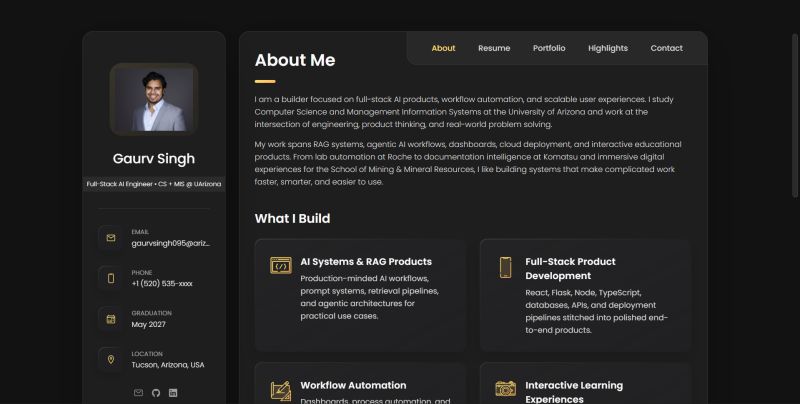
Portfolio website demo used during the workshop.
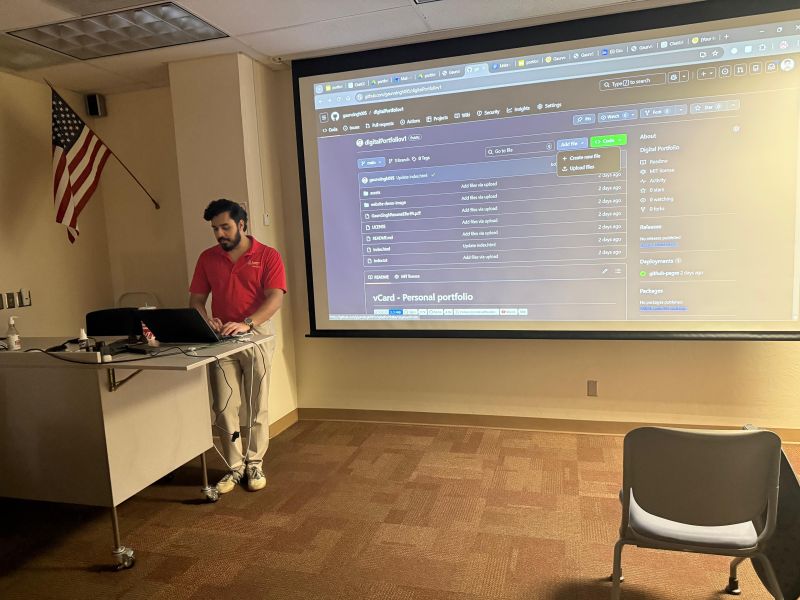
Live instruction for the resume-to-portfolio workflow.
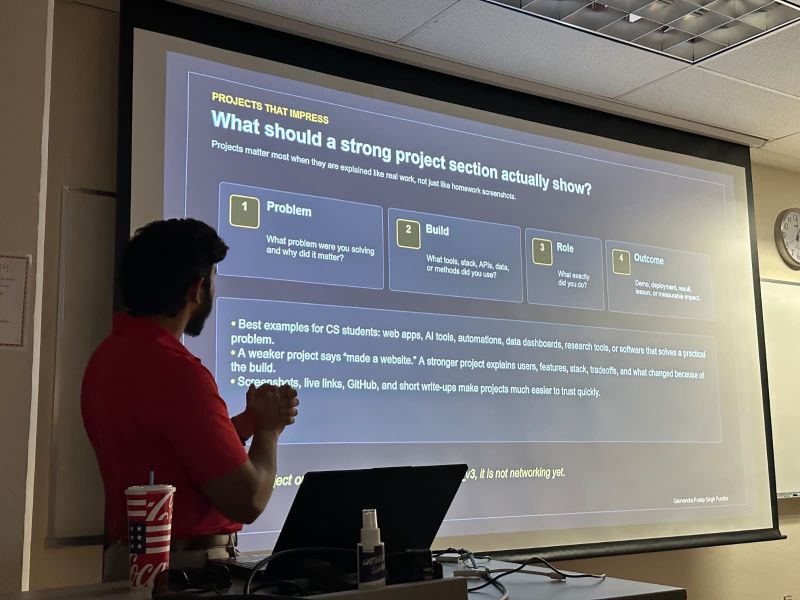
AI and portfolio-building presentation for students.
What I learned
Portfolio building is not just design. It is translation.
The hard part is turning experience into proof, and proof into a clear public story.
I also learned that the best career-readiness tools reduce starting friction. Students do not always need more abstract advice. Often, they need a working template, a clear process, and enough confidence to publish the first version.