
Komatsu RAG Documentation System
A retrieval-augmented generation system designed to make technical documentation easier to search, retrieve, and use through a full-stack AI experience.
- ↗ Built a RAG/LLM documentation system to reduce manual documentation search effort.
- ↗ Developed scalable backend architecture with Flask and a React + TypeScript frontend.
- ↗ Explored deployment with CyVerse infrastructure, NGINX, Gunicorn, and Linux VMs.
- ↗ Strengthened experience in retrieval, source-grounded generation, and infrastructure.
Overview
At Komatsu, I worked on a retrieval-augmented generation system designed to streamline technical documentation workflows.
The problem was familiar across many organizations: valuable knowledge existed, but finding the right information took too much manual effort.
The project connected AI retrieval, LLM response generation, backend architecture, frontend usability, and deployment exploration into one full-stack system.
The problem
Technical documentation is only useful when people can find the right answer at the right time.
Traditional search often fails when users do not know the exact terminology, when documents are spread across sources, or when answers require context from multiple places.
The product goal was to reduce the friction between a question and a useful answer.
Users and stakeholders
The primary users were documentation consumers: engineers, operators, or team members who needed faster access to technical information.
The broader stakeholder group included teams responsible for documentation quality, accuracy, workflow efficiency, and internal knowledge access.
My role
I worked as an SDE intern and AI systems builder.
I contributed to the RAG architecture, backend development, React + TypeScript frontend integration, and deployment exploration using Linux infrastructure tools.
My work sat across the full product and technical stack:
- Retrieval and source-grounded response flow
- Flask backend architecture
- React + TypeScript frontend experience
- API integration between the AI workflow and user interface
- Linux VM deployment exploration
- NGINX and Gunicorn infrastructure setup considerations
Product decisions
The most important product decision was to make the system source-grounded.
A useful enterprise AI documentation tool cannot simply generate plausible answers. It has to retrieve relevant context, use that context to respond, and support user trust.
That meant thinking about:
- Document ingestion
- Retrieval quality
- Query handling
- Response grounding
- User interface clarity
- Deployment constraints
- How users evaluate whether an answer is reliable
Technical approach
The system used a Flask backend integrated with a React + TypeScript frontend.
The AI workflow centered on retrieval-augmented generation with Llama-based language model capabilities.
I also explored deployment using CyVerse infrastructure, NGINX, Gunicorn, and Linux VM workflows.
This gave me hands-on experience across the full stack: AI pipeline, API design, frontend integration, and production-style infrastructure.
Impact
The project was designed to reduce manual documentation effort and improve access to technical information.
It gave me a strong foundation in how AI systems need to be built for real workflows, not just isolated demos.
The core value was not just “chat with documents.” The value was helping users move from scattered documentation to grounded, usable answers faster.
Visual proof
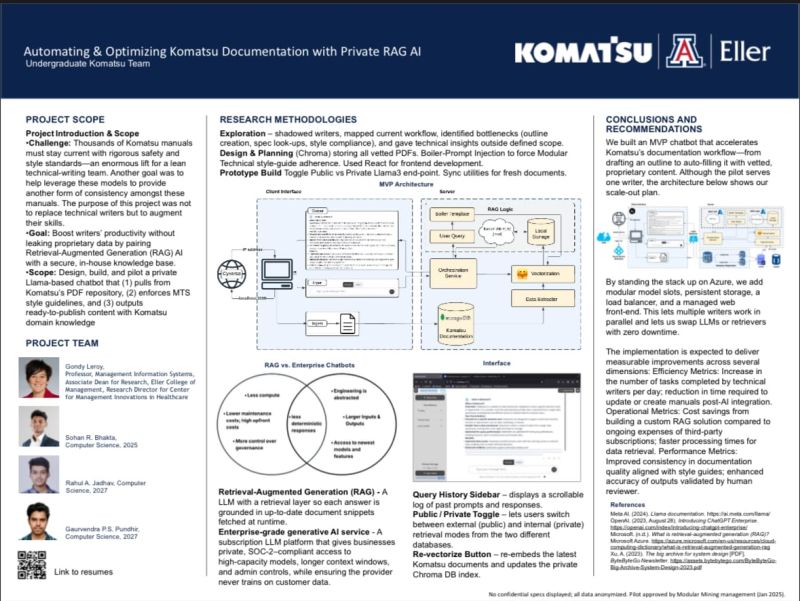
Poster overview of the Komatsu RAG documentation automation system.
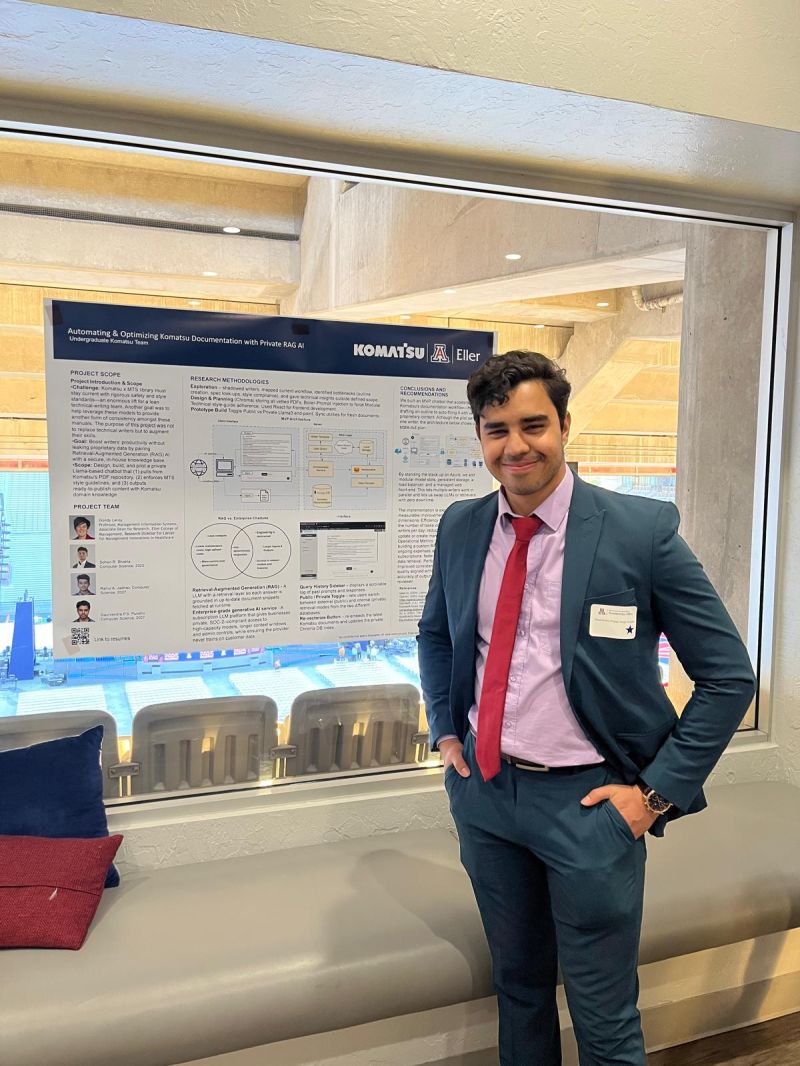
Presentation day poster visual for the RAG documentation project.
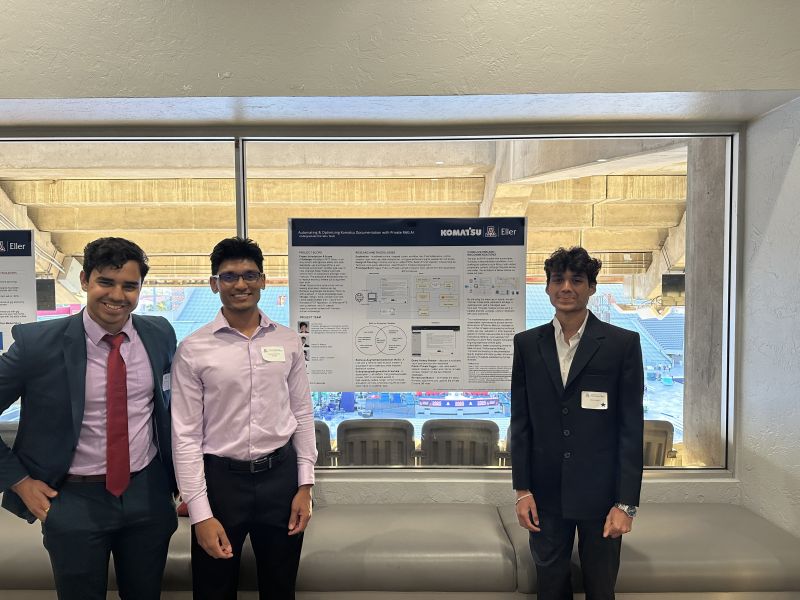
Team presentation visual for the Komatsu engagement.
What I learned
RAG systems are not just “chat with documents.”
The hard parts are source quality, chunking, retrieval, evaluation, UX, and trust.
A RAG product succeeds when users can ask better questions, get grounded answers, and understand why the answer is reliable.
This project helped me understand that enterprise AI systems need more than a model. They need workflow fit, retrieval quality, interface clarity, and deployment discipline.